
What is MRP Software? Complete Guide for Manufacturers (2026)

Material Requirements Planning (MRP) software is a system used by manufacturers to plan production, manage inventory, and ensure that materials are available at the right time. According to Material Requirements Planning (MRP), it is a method for calculating the materials and components needed to manufacture a product.
At its core, MRP answers three essential questions: what materials are required, how much is needed, and when they must be available. By automating these calculations, manufacturers move from manual planning to data-driven decision-making and gain control over increasingly complex operations.
Why MRP Software Matters for Modern Manufacturers
For many small and mid-sized manufacturers, operations begin with spreadsheets or disconnected systems. While this approach may work in the early stages, it quickly becomes a bottleneck as order volume increases and supply chains become more complex.
Without a centralized system, teams often rely on manual coordination between departments. Sales, production, and purchasing operate in silos, which leads to delays, miscommunication, and costly errors.
MRP software replaces reactive workflows with proactive planning. Instead of responding to shortages after they occur, businesses can anticipate demand and ensure that materials and resources are available in advance.
According to industry research from McKinsey Operations Insights, manufacturers that adopt digital planning systems see measurable improvements in efficiency, cost control, and supply chain resilience.
This shift is especially important for SMB manufacturers. As businesses grow, even small inefficiencies multiply quickly. MRP provides the structure needed to scale operations without losing control.
How MRP Software Works
MRP systems rely on a structured set of inputs to generate accurate production and purchasing plans.
The first input is the bill of materials (BOM), which defines every component required to produce a finished product. The second is inventory data, including current stock levels, lead times, and supplier information. The third is demand, which typically comes from sales orders or forecasts.
Using these inputs, the system calculates what needs to be produced or purchased and when. The output includes work orders, purchase orders, and updated inventory projections.
Standards organizations such as the National Institute of Standards and Technology (NIST) emphasize the importance of integrated systems in improving manufacturing efficiency and data accuracy.
This process runs continuously. As new orders are placed or inventory levels change, the system recalculates requirements in real time. This ensures that production stays aligned with demand even in dynamic environments.
Key Features of MRP Software
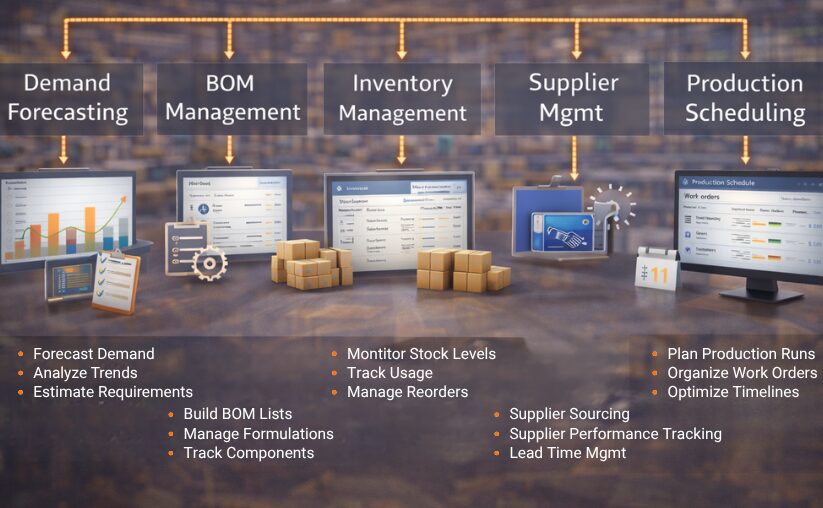
Modern MRP systems include several core capabilities that enable efficient manufacturing operations.
Demand forecasting allows businesses to anticipate future requirements based on historical trends and current data. Production scheduling ensures that resources such as labor, materials, and equipment are allocated efficiently.
Inventory management goes beyond tracking stock levels by providing visibility into future needs. This helps businesses avoid both shortages and excess inventory.
Supplier management tracks lead times and vendor performance, ensuring materials arrive when needed. Reporting and analytics provide insights into performance, helping managers identify bottlenecks and optimize processes.
Together, these features create a connected system where planning, execution, and monitoring are aligned.
Real-World Use Case: MRP in Action
Consider a mid-sized manufacturer producing electronic components. Before implementing MRP, the company relies on spreadsheets and manual planning.
As order volume increases, discrepancies begin to appear. Components run out unexpectedly, production schedules become unreliable, and excess inventory builds up in slower-moving areas.
After implementing MRP software, the company gains real-time visibility into inventory and demand. Purchase orders are generated automatically, production schedules adjust dynamically, and inventory levels become more accurate.
Within a few months, the company improves on-time delivery rates and reduces operational inefficiencies. Teams spend less time managing data and more time focusing on production and growth.
MRP vs ERP: Understanding the Relationship
MRP focuses specifically on production planning and inventory management, while ERP (Enterprise Resource Planning) systems provide a broader framework that integrates all business functions.
ERP systems connect finance, sales, inventory, and operations into a single platform. In most modern solutions, MRP is a module within a larger ERP system.
The key difference is scope. MRP solves production challenges, while ERP connects the entire organization.
For a deeper comparison, see ERP vs MRP.
Benefits of MRP Software
MRP software provides several key benefits that directly impact business performance.
It improves inventory accuracy by tracking materials in real time and forecasting future needs. It enhances production efficiency by automating scheduling and resource allocation.
It supports better decision-making by providing accurate, up-to-date data. Managers can respond quickly to changes in demand or supply chain conditions.
It reduces costs by optimizing inventory levels and minimizing waste. Finally, it improves customer satisfaction by ensuring reliable delivery timelines.
Common Challenges Without MRP
Without MRP software, manufacturers often face recurring issues.
Inventory becomes unreliable, leading to stockouts or excess materials. Production schedules are difficult to manage, resulting in delays and missed deadlines.
Teams spend significant time reconciling data between systems, which reduces productivity and increases the likelihood of errors.
As businesses grow, these challenges become more severe. What once seemed manageable quickly becomes a barrier to scalability.
MRP addresses these issues by providing a structured, automated approach to planning and execution.
MRP in Cloud-Based Manufacturing Systems
Today, MRP is rarely implemented as a standalone tool. Instead, it is typically part of a broader cloud-based manufacturing ERP system.
This integration connects production planning with inventory, purchasing, and financial data, creating a single source of truth across the organization.
Cloud-based systems offer additional advantages, including remote access, automatic updates, and scalability as the business grows.
Learn how MRP fits into a complete system in our Cloud-Based Manufacturing Software Guide.
How to Choose the Right MRP Software
Choosing the right MRP system depends on your business needs and operational complexity.
Smaller manufacturers may prioritize ease of use and quick implementation. Larger or more complex operations may require advanced features such as capacity planning, multi-location inventory management, and deeper integrations.
It is important to consider scalability. A system that works today should also support future growth without requiring a complete replacement.
Integration is another key factor. Systems that connect seamlessly with accounting, sales, and supply chain tools provide greater long-term value.
Implementation Timeline and Expectations
Implementing MRP software typically takes between 30 and 120 days for SMB manufacturers, depending on the scope and complexity of the project.
A phased approach is often the most effective. Starting with core functions such as inventory and production planning allows teams to adapt before expanding into additional modules.
Training and change management are critical. Employees need to understand how the system improves their workflows, not just how to use it.
For a detailed walkthrough, see our Manufacturing ERP Implementation Guide.
MRP software is a foundational tool for manufacturers looking to improve efficiency, reduce costs, and scale operations effectively.
By automating planning and providing real-time visibility, it enables businesses to move from reactive decision-making to proactive management.
For SMB manufacturers, adopting MRP is often the first step toward a fully integrated ERP system that supports long-term growth.
For a broader comparison of solutions, explore our Best Manufacturing ERP for Small Businesses guide.
Key Takeaways
MRP software aligns production, inventory, and purchasing through automated planning.
Cloud-based ERP systems extend MRP by connecting all business operations into a unified platform.
Successful implementation depends on planning, training, and phased rollout.
Choosing the right system requires balancing usability, scalability, and integration.
➤ See Kechie in action: Schedule your free ERP demo
Frequently Asked Questions
What does MRP software do in manufacturing?
MRP software helps manufacturers plan production, manage inventory, and ensure materials are available when needed. It automates calculations based on demand, inventory levels, and production schedules.
Is MRP the same as ERP?
No. MRP focuses on production planning and inventory, while ERP is a broader system that includes finance, sales, and operations. MRP is often a module within ERP.
Who should use MRP software?
MRP is ideal for manufacturers that need better control over inventory and production but do not yet require full business integration.
What are the main benefits of MRP?
MRP improves inventory accuracy, reduces stockouts, optimizes production scheduling, and lowers operational costs.
Can MRP work without ERP?
Yes, but it may create limitations as the business grows. Many companies eventually move to ERP for better integration.
In This Article
-Why MRP Software Matters for Modern Manufacturers
-How MRP Software Works
-Key Features of MRP Software
-Real-World Use Case: MRP in Action
-MRP vs ERP: Understanding the Relationship
-Benefits of MRP Software
-Common Challenges Without MRP
-MRP in Cloud-Based Manufacturing Systems
-How to Choose the Right MRP Software
-Implementation Timeline and Expectations
-Final Thoughts
-Key Takeaways