
ERP vs MRP: What’s the Difference for Manufacturers? (2026 Guide)
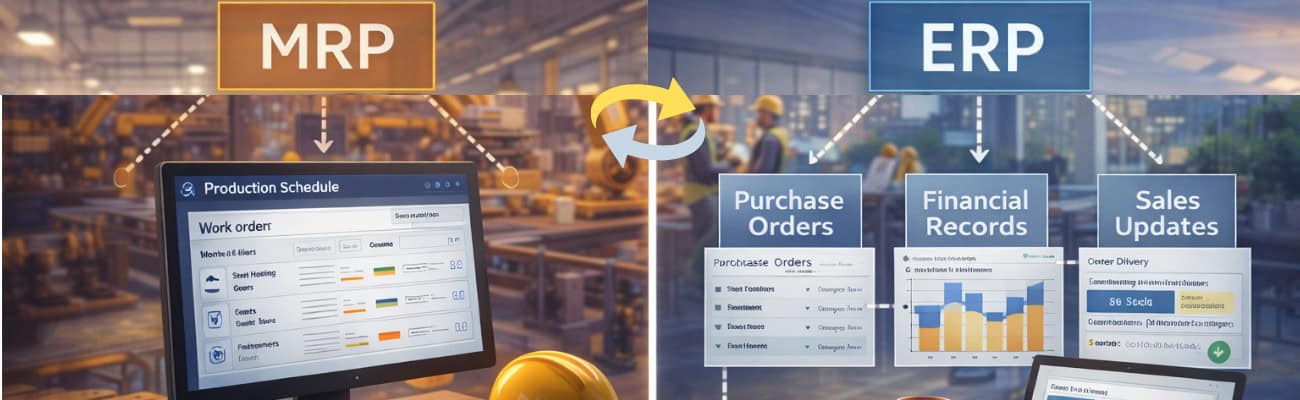
Enterprise Resource Planning (ERP) and Material Requirements Planning (MRP) are two of the most important systems in modern manufacturing. While they are closely related, they serve different purposes and operate at different levels within a business.
At a high level, MRP focuses on production planning and inventory management, while ERP integrates all business processes—including finance, sales, inventory, and operations—into a unified system. Understanding the distinction between ERP and MRP is essential for manufacturers looking to scale efficiently, reduce operational complexity, and improve decision-making.
What is MRP?
Material Requirements Planning (MRP) is a system designed to ensure that the right materials are available at the right time for production. According to Material Requirements Planning, it is a method used to calculate the materials and components needed to manufacture a product.
MRP systems rely on three key inputs: the bill of materials (BOM), inventory data, and demand. By analyzing these inputs, the system determines what needs to be produced or purchased and when.
In practice, this means that when a sales order is entered, the system automatically calculates the required materials, checks current inventory, and generates production or purchasing actions. This eliminates guesswork and reduces the risk of shortages or delays.
MRP is especially valuable for manufacturers dealing with complex assemblies or variable demand. It provides structure to what would otherwise be a highly manual and error-prone process.
For a deeper breakdown of how MRP works, see our guide on
👉 https://myofficeapps.com/what-is-mrp-software
What is ERP?
ERP (Enterprise Resource Planning) is a broader system that integrates all core business functions into a single platform. Instead of focusing only on production, ERP connects finance, sales, purchasing, inventory, and operations.
The primary goal of ERP is to create a single source of truth. When data is entered into the system—such as a customer order—it automatically updates across all departments.
This means that sales teams can see production timelines, finance teams can track revenue in real time, and operations teams can adjust schedules based on demand. The result is a more coordinated and efficient organization.
Industry organizations such as ASCM (Association for Supply Chain Management) emphasize the importance of integrated systems in modern manufacturing environments, particularly as supply chains become more complex.
For a broader overview of how these systems work in the cloud, see Cloud-based Manufacturing Software
The Core Difference Between ERP and MRP
The difference between ERP and MRP ultimately comes down to scope and integration.
MRP is focused on production planning. It ensures that materials are available and that production schedules align with demand. ERP, on the other hand, connects the entire business.
While MRP answers operational questions such as what to produce and when, ERP answers broader questions about performance, profitability, and efficiency across the organization.
In most modern systems, MRP is not replaced by ERP—it becomes part of it. ERP systems include MRP as one of several integrated modules.
ERP vs MRP Comparison
ERP systems provide broader capabilities across the organization, while MRP focuses specifically on production planning.
How ERP and MRP Work Together
Rather than being competing systems, ERP and MRP are complementary.
MRP handles the detailed planning of production. ERP ensures that all departments are aligned with that plan.
For example, when MRP generates a production schedule, ERP ensures that purchasing orders are created, financial records are updated, and sales teams have visibility into delivery timelines.
This integration eliminates the need for manual coordination between departments. It reduces errors, improves efficiency, and creates a more responsive organization.
Standards bodies such as the International Organization for Standardization (ISO) highlight the importance of integrated systems in maintaining quality and consistency in manufacturing processes.
When MRP Is Enough
For smaller manufacturers or those with relatively simple operations, MRP alone may be sufficient.
If a business primarily needs better inventory control and production planning, MRP can deliver significant value without the complexity of a full ERP system.
In these cases, MRP provides a strong foundation for improving efficiency. It introduces structure, reduces manual work, and helps ensure that production runs smoothly.
However, this approach has limitations. As the business grows, the lack of integration between departments can create new challenges.
When ERP Becomes Necessary
ERP becomes essential when a business reaches a level of complexity that requires coordination across multiple departments.
This typically happens when operations expand, product lines increase, or financial tracking becomes more sophisticated.
At this stage, relying on separate systems for production, finance, and sales creates inefficiencies. Data must be manually reconciled, and visibility is limited.
ERP solves this by integrating all processes into a single system.
According to research from Deloitte Manufacturing, digital transformation initiatives—including ERP adoption—significantly improve operational performance and supply chain visibility.
Benefits of ERP Over MRP
While MRP provides strong production planning capabilities, ERP offers additional advantages that support long-term growth.
ERP enables unified data across departments, allowing businesses to make decisions based on accurate and up-to-date information. It provides real-time financial insights, helping leaders understand profitability and manage cash flow more effectively.
It also improves scalability. As the business grows, ERP systems can expand to support additional users, locations, and processes without requiring a complete overhaul.
Perhaps most importantly, ERP eliminates data silos. Instead of relying on multiple disconnected tools, businesses operate from a single platform.
Implementation Considerations
Choosing between ERP and MRP is not just a technical decision—it is a strategic one.
MRP systems are generally easier and faster to implement because they focus on a specific area of the business. ERP systems, by contrast, require broader planning and coordination.
A phased approach is often the most effective way to implement ERP. Businesses can start with core modules such as inventory and production, then expand into financials and advanced features over time.
Training and change management are critical. Employees need to understand not only how to use the system, but how it improves their workflows.
For a detailed breakdown of implementation steps, see
👉 https://myofficeapps.com/manufacturing-erp-implementation-guide
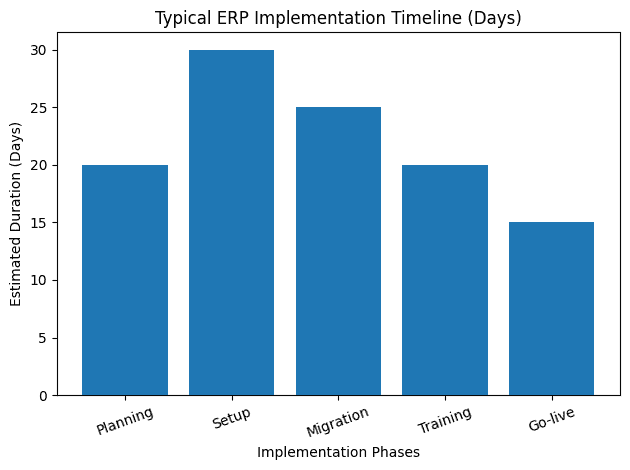
ERP implementations typically follow a phased approach, allowing teams to adapt gradually.
Real-World Example: Transition from MRP to ERP
Consider a manufacturer that initially adopts MRP to improve production planning.
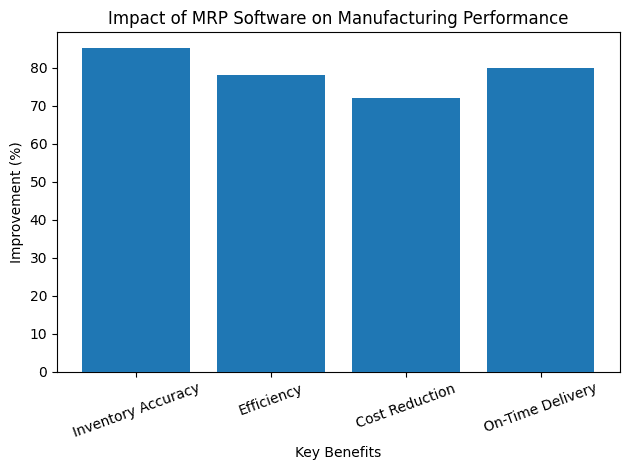
At first, the system delivers significant benefits. Inventory becomes more accurate, production schedules improve, and manual work is reduced.
However, as the business grows, new challenges emerge. Financial data is managed separately, sales teams lack visibility into production timelines, and coordination becomes more complex.
By transitioning to ERP, the company integrates all processes into a single system. This eliminates inefficiencies and provides a clearer view of operations.
Within months, the business sees improvements in decision-making, efficiency, and overall performance.
Choosing the Right Path for Your Business
The decision between ERP and MRP depends on your current needs and long-term goals.
If your primary challenge is production planning, MRP may be the right starting point. If your goal is to integrate and scale your entire business, ERP is the better choice.
Many manufacturers begin with MRP and transition to ERP as their operations become more complex.
For a comparison of available solutions, see Kechie Manufacturing Software
Final Thoughts
ERP and MRP are not competing solutions—they are part of the same evolution.
MRP provides the foundation for efficient production planning, while ERP builds on that foundation to create a fully integrated business system.
For manufacturers looking to grow, the goal is not just to adopt software, but to implement a system that supports long-term scalability, efficiency, and visibility.
Frequently Asked Questions
What is the main difference between ERP and MRP?
MRP focuses on production planning and inventory, while ERP integrates all business processes including finance, sales, and operations.
Should I choose ERP or MRP first?
If your main challenge is production planning, start with MRP. If you need full business visibility and integration, ERP is the better choice.
Is MRP included in ERP systems?
Yes. Most modern ERP systems include MRP as a core module for production planning.
Why do companies switch from MRP to ERP?
As businesses grow, they need better integration across departments. ERP eliminates data silos and improves visibility.
Is ERP more expensive than MRP?
Generally yes, but it provides more value by integrating all business operations into a single system.
Key Takeaways
- ERP integrates all business functions, while MRP focuses specifically on production planning.
- MRP is typically a module within a broader ERP system.
- Businesses often transition from MRP to ERP as complexity increases.
- Choosing the right system depends on both current needs and future growth.
In This Article
-ERP vs MRP: What’s the Difference for Manufacturers? (2026 Guide)
-What is MRP?
-What is ERP?
-The Core Difference Between ERP and MRP
-How ERP and MRP Work Together
-When MRP Is Enough
-When ERP Becomes Necessary
-Benefits of ERP Over MRP
-Implementation Considerations
-Real-World Example: Transition from MRP to ERP
-Choosing the Right Path for Your Business
-Final Thoughts
-Frequently Asked Questions